Comments

Monday, April 9, 2018

Methodological sadism

Methodological sadism (MS) is quite fashionable nowadays and nothing gets practitioners more excited than the possibility that someone somewhere is proposing something interesting (i.e. something that reaches beyond the sensory surface of things and that might possibly reveal some of the underlying mechanics of reality). You’ve all met people like this,[1] and one of their distinctive character traits is a certain (smug?) assurance that when it comes to the philosophy of science, they are on the side of the angels. They love to methodologically demarcate the boundaries of legitimate inquiry so as to protect the weak minded from fake science.

Of course, the standard demeanor of MSers is severe. Yes they are tough. But standards must be maintained lest we slide joyfully to our scientific perdition. Like I said, you’ve all met MSers. Nowadays, at least in my little domain of inquiry, they are the media stars and have done a pretty good job convincing the outside world (and some on the inside) that GG is dead and that there is really nothing special about the cognitive powers required for language. I think that this is deeply wrong, and will write another brief arguing as much in the next post. But for now, I want to, once again, offer some prophylaxis against the most rabid form of MS, falsification.  Here is a useful short antidote, a paper (which I will refer to as ‘AB’ (Adam Becker is author)) that touches all the right themes. Its main claim is that trying to demarcate science from non-science is a mugs game that relies on ignoring how real successful domains of inquiry have grown.

So what are the main themes?

First AB points out that SMers (my term not AB’s) adhere to a basic erroneous principle: “that a new theory shouldn’t invoke the undetectable” (2).[2] Why? Because this makes it “unfalsifiable.”  So, observability underlies falsifiability and both are used by “self-appointed guardian[s], who relish dismissing some of the more fanciful notions in physics, cosmology and quantum mechanics [and linguistics! NH] as just so many castles in the sky” in order to protect science from “from all manner of manifestly unscientific nonsense” (2).

There are ways of understanding falsifiability that seem unobjectionable, namely that theories that never can have observable consequences are thereby undesirable. Well, yeah. The problem is that this is a very low bar, and any stronger version that “turn[s] ingenuity into fact” must be “much more nuanced” (2). Why? Because falsifiability is hardly ever possible and observability is undefinable. Let’s consider both of these facts seriatim.

First falsifiability. This is impossible for scientific theories for the simple reason that any falsification can be patched up with the right ad hoc statement, leaving the rest of the theory the same. As AB puts it (correctly) (2):

Falsifiability doesn’t work as a blanket restriction in science for the simple reason that there are no genuinely falsifiable scientific theories. I can come up with a theory that makes a prediction that looks falsifiable, but when the data tell me it’s wrong, I can conjure some fresh ideas to plug the hole and save the theory.

Any linguist knows how true this is. Moreover, it is easier the less brittle a theory is, and our current theories tend to be very labile. You can bend them in many directions without ever hearing a creak let alone inducing a crack or a break. You loose nothing when adding a bespoke principle to explain recalcitrant data because the only thing there is to loose in doing this is explanatory power and there was not much of this to begin with in flexible theories. However, even with good theories that have some oomph, it is generally possible (I would say “always possible” but I am being mealy mouthed here) to plug the hole and carry on.  One of the virtues of AB is that it provides some nice historical examples of this happening. As AB notes, the history of science is full of them.

AB recounts the famous one where Uranus’ odd (apparently non Newtonian) orbit begats Neptune, which in turn begats Vulcan to explain Mercury’s perihelion which finally fails when General Relativity replaces Newton. AB notes that each historical move makes sense and that looking for Neptune (victory!) and looking for Vulcan (failure!) were both rational despite the different outcomes.  Of course, with hindsight, Neptune is a bold prediction that strengthens the theory and Vulcan turns out to have been just an unfortunate wrong turn. But Vulcan did not lead to people jumping the Newtonian ship. Rather “astronomers of the time collectively shrugged and moved on” (4). And rightly so. Do you really want to give up Newton just because Vulcan was impossible to spot? What then do you do with all the other stuff it does explain?

Note that this means that there is an asymmetry between potentially falsifying experiments that succeed and those that don’t. The former are declared as triumphs of the scientific will, while the latter are quietly shelved and de-emphasized (or, more accurately, added to the ledger of anomalies that a discipline collects as targets for yet unknown superior explanations yet to come). No reason to show these off in public and take the shine from the powerful rational methods of scientific inquiry.

Of course, one might eventually hit the jackpot and find the anomalies resolved with the right new theory. Mercury was a feather in General Relativity’s cap. And well it should have been, for it allowed us to dump Vulcan and replace it with a story that allowed us to also keep all the good parts of Newton. So yes exceptions prove the rule in the sense that Newtonian exceptions prove (justify) Relativity’s rules.

AB provides other examples, one of the best being Pauli’s proposal to save the Law of the Conservation of Energy via the neutrino. It took over 25 years to prove him right (it’s good to have descendants like Fermi who get interested in your ideas). But what is interesting is not merely the long wait time, but why it took so long: the neutrino had no properties at the time that Pauli proposed it that could have allowed it to be detected. So when Pauli proposed it, the theory was unfalsifiable because its basics were unobservable. But, as history shows, wait 25 years and who knows what unobservables might become detectable. As AB again, rightly, puts it (5):

It’s certainly true that observation plays a crucial role in science. But this doesn’t mean that scientific theories have to deal exclusively in observable things. For one, the line between the observable and unobservable is blurry – what was once ‘unobservable’ can become ‘observable’, as the neutrino shows. Sometimes, a theory that postulates the imperceptible has proven to be the right theory, and is accepted as correct long before anyone devises a way to see those things.

Not only is ‘observable’ irreparably vague, but MSers also often make a second more extreme demand concerning its applicability. They require theory to only postulate constructs with directly observable magnitudes. Laws of nature then simply relate “directly observable quantities” and make no reference “to anything unobservable at all” (6). This was essentially Mach’s views and, in hindsight, they served to hamstring scientific insight. For example, as AB notes, Mach opposed atomic theory as unscientific. Why? Well you cannot “see” atoms. Of course, as many pointed out, there is lots to be gained by postulating them (e.g. you can derive the principles of thermodynamics and explain Brownian motion). But this was not good enough for Mach, nor for current day MSers. So how did Mach’s views hold up? Well, it cost Walter Kaufman a Nobel Prize apparently and might have led to Boltzmann’s suicide, but aside from that it did not do any real damage because the scientific community largely ignored Mach’s injunctions.

But isn’t postulating unseen elements unscientific? Well no. Note: even if we all agree that theory must have discernible (aka observable) consequences so that it can be tested/verified, this does not imply that every part of the theory must invoke elements whose properties are directly observable. Of course, it is nice if one can do this. It is always nice to be able to measure. But the idea that the only thing worth doing is relating (perhaps statistically) the magnitudes of observable quantities is something that would sink our best sciences if implemented. And this is a good reason not to do it![3]

One can go further, and AB does. The notion of an observable is itself fundamentally obscure. It cannot mean, observable given “current” technology, for that is too strong. As the history of the neutrino “discovery” indicates, taking this position would have led away from the truth, not towards it. But it cannot mean “observable in principle” for this is irremediably vague. If we mean that it is not “logically possible” to observe what but contradictions will fail. If we mean given current technology or current theory it is too strong. So what then? AB, quotes Grover Maxwell as observing” “There is no a priori or philosophical criteria for separating the observable form the unobservable.” The best we can say is that theories with observable consequences are better situated than those without ceteris paribus. But what goes into the ceteris paribus determination is forever up for grabs, and subject to the inconclusive (yet critically important) vagaries of judgment. No method, just mucking around, always.

AB makes a last observation I’d like to highlight: unlike many, AB emphasizes that part of the scientific enterprise is building “sky-castles.” This is not a scientific aberration, nor an example of science misfiring, but part of the central enterprise. For the scientist (including the linguist see here) “[s]pinning new ideas about how the world could be – or in some cases, how the world definitely isn’t – is central to their work” (2). Explanation leans heavily on the modal ‘could’ in the quote. Not just what you see or mild extensions thereof, but what could be and couldn’t. That’s the stuff of understanding and as AB notes, again rightly, “[the] goal of scientific theory is to understand [my emphasis, NH] the nature of the world with increasing accuracy over time.”

Methodological sadists, if given power, would sink scientific inquiry. They would make it nearly impossible to uncover unobservable mechanisms for they are an inherent part of all decent explanation in the sciences. MSers undervalue explanation and hence distrust the speculation required to get any. As AB notes, their dicta are at odds with the history of science. They are also deeply obscure. So historically misguided and irredeemably obscure? Yes, but also sadistically useful. MSers sound tough minded (just the facts kinda people) but really they are hopeless romantics, stuck with a view of method and inquiry that successful inquiry has largely ignored, as linguists should as well, at least if they want to get anywhere.


[1] Pullum, Haspelmath, Tomasello and Everett are prominent examples of such in my own little world.
[2] The strong form would say that no theory should, not only new ones. However, MSers generally aspire to be gatekeepers and, in practice, this means keeping out the new. Facing out, rather than in, also has one important advantage. It is pretty hard to argue that accepted results are suspect without making one’s methodological injunctions sound dumb (recall, that every modus ponens comes with an equally powerful modus tolens). Consequently, fire is reserved for the novel, which is always deemed to differ from the accepted in being methodologically deficient. Note that being methodologically deficient has its virtues in argument. It relieves the critic of actually having to go into details, of having to do the hard work of arguing against actual results. MSers generally paint with a broad methodological brush, and I would argue that this is the reason why.
[3] Linguists here should be thinking of those that take Greenberg universals to be the only kinds that are legit (e.g. the crowd in note 1). Why do this? Well because as MSers they demand that science eschew the unobservable. Greenberg universals just are estimates of co-occurrence (either categorical or probabilistic) among surface visible language properties. Chomsky universals are not, and this is why for MSers Chomsky Universals are verboten.

Saturday, April 7, 2018

Boring details

Bill Idsardi & Eric Raimy


Recall from last time that we are trying to formalize phonology in terms of events (e, f, g, … .; points in abstract time), distinctive features (F, G, … ; properties of events), and precedence, a non-commutative relation of order over events (e^f, etc.). So far, together this forms a directed multigraph.

Inspired by a challenge from Greg Hickok, we’ll see how far we can get with those things without assuming explicit constructs such as sets of features constituting segments (viz subgraphs, more on this in a later post). We will try to avoid falling victim to the pitfalls cautioned against by Kazanina, Bowers & Idsardi 2017 by allowing events to have multiple properties (but we won’t bother collecting up such properties into sets either). Another way to put this point might be to say that we will attempt to cast segments as an emergent phenomena, arising out of features and order (oooh, that sounds so much better). We picked events, features and precedence for inclusion in the model precisely because they are substantive (admittedly, the points in time are pretty abstract), and provide a reasonable starting point for effectual interfaces to action and perception.

Special shit we need:

  • #: an event such that ∀ e NOT e^# (yes, this entails NOT #^#)
  • %: an element such that ∀ e NOT %^e (yes, NOT %^%)
  • $: an empty element, see below. (Think juncture or instantaneous $ilence.)

# codes the beginning of time. (Not the Big Bang, just the abstract time under consideration in the current “workspace”.) % codes the end of time. (And I can’t bring myself to search for a Big Bang Theory quote.) # and % are always available. (I.e. in every workspace instance, see below. We’re building toward MERGE for workspaces. Ideally MERGE(π1,π2) is just the simple union of events, features and relations in both workspaces. But there’s no way it’s quite that simple.)

Another piece of substance that we might want to include is logical relationships among properties. We believe that some of these are universal, but some could also be induced by the learner and so could vary across languages. In particular, for now, we will include the basic feature co-occurrence restrictions and dimensional organization from Avery & Idsardi 1999 (A&I). (In a later post we’ll back off on this and see what being more permissive can buy us.) In the present context this means a couple of things. First, we include in the model the substance of the agonist/antagonist organization of the features (where a NAND b = NOT (a AND b), showing that I [wji] have been disparaging NAND for too long [fn: NAND and NOR are the only logical primitives that alone form a complete basis for the binary logical functions]):

(1) NANDs

  • [spread] NAND [constricted]
  • [stiff] NAND [slack]
  • [raised] NAND [lowered]
  • [high] NAND [low]
  • …

Again, we see this as an empirical claim about phonology. If a good use for e.g. [high, low] events can be found then these conditions should be dropped. (And this is the sort of thing that we will explore later.) These are well-formedness conditions on phonological representations, and would govern rules//laws such that all rules/laws have to obey (1); (1) counts as part of the theory of “possible phonological rule/law”. How they manage to obey (1) is a matter for investigation. 

Second, there are statements like IF F THEN G, meaning  ∀ e IF Fe THEN Ge. (We don’t use the usual symbolic logic symbol for implication, →, because we also want to do graph operations as rules which will also use →.  Another common symbol for implication, ⊃, is also used in set theory, so it has similar problems. So we’ll just spell it out.) Therefore, UG has statements like the following:

(2) IF-THENs

  • IF [spread] THEN [GW]
  • IF [GW] THEN [Laryngeal]
  • ...


If we want to go the whole way to capturing the “bare dimensions” in the A&I framework (and at least one of us does), then we would also have statements like:

(3) XORs

  • IF [GW] THEN [spread] XOR [constricted] 


Given (1), could use OR here instead as F XOR G = (F OR G) AND (F NAND G). (3) would hold at the interface to the motor system but only there, i.e. no bare [GW] sent to the motor system, but bare [GW] is a possible representation in LTM (see A&I) or from the auditory system (= “there was something funky with the voice quality, but I’m not sure what”). This allows for special kinds of underspecification. Anthropomorphizing, a simple [GW] event on its way to the motor interface doesn’t yet know if its [spread] or [constricted] but it will be one or the other (called completion in A&I). 

So far, we believe that this approach is broadly consistent with Jardine 2016. In our terms, Jardine adds another temporal relation (association) between events, we could notate that as e|f, indicating that e is associated to f. (On the “meaning” of association lines see Coleman and Local 1991, Sagey 1986, in the present context we could understand it as weak synchronization, “at about the same time”, recall Saberi & Perrott 1999). In that case there might also be universal restrictions on the combination of these two relations, something like ∀e,f IF e|f THEN NOT e^f AND NOT f^e. But given things like loops in time, this question is not nearly as simple as it first appears. Taking a minimalist position on this question, we will not include | here (but think about ASL again). 

To get theories like Mielke 2008, just start with a different set of features, ones that denote whole “segments,” e.g. [ʊ]e, and then invent/discover/define/select classificatory properties like [round]:

(*4) IF [u] OR [ʊ] OR [o] OR … THEN [round]

Since we’re not going to adopt Mielke’s approach either, we’ve put * in front of 4 to mean that we’re not including it in our model (using the * is actually us trying to trick syntacticians into reading along). Obviously, you could turn such statements around also, IF [round, high, back, ATR, …] THEN [u], but it’s not clear to us what work we would do with [u] if we’ve got the features already. For circuit fanatics, (4) implies a disjunctive relationship between “primary” and “secondary” percepts; if features come “first” then it’s a conjunctive coding in the “second layer” instead. (We're sure the brain does both kinds of things.) 

This brings us to an important point, we have not said anything about how many fneurons (features, properties) an event can have. We could include into the theory statements that make events as simple as possible, meaning that phonological representations would be maximally “scattered”, i.e. have a maximal number of events because each event would have at most one feature. The statement that would do this is:

(*5) ∀ F, G such that F ≠ G, F NAND G 

Statement (5) has an important property, it’s a monadic second order formula because it is  quantifying over properties. This is obscured because we wrote it in a "pointfree" style (the term is from Haskell), so let’s restate it making the event variable clear:

(*6) ∀ e ∀ F, G such that F ≠ G, Fe NAND Ge
(alternatively, ∀ e ∀ F, G IF [F, G]e THEN F = G)

We are quantifying over two different kinds of things, events and monadic properties, and the distinctness criterion (F ≠ G) is over properties, not events (which could be construed extensionally as the set of events Fe and the set of events Ge, but we will resist this interpretation and see properties and functions as first-class, as in Haskell). 

We think that Theory(*6) is an interesting idea to pursue, but we won’t include (*6) here either (we’re fickle like that). That means that events can have multiple properties for us.

Properties in either the articulatory and auditory system can certainly overlap in time. If such “bindings” are recognized by, say, the perceptual system, that information could be conveyed into the phonology as a single event with multiple properties, e.g. [front, round]e. In passing we note that what the phonology receives from perception can be incomplete or distorted in all sorts of ways, but that the phonology trudges on to LTM anyway, despite occlusion (phoneme restoration effects), tinnitus, temporally reversed speech, and so on. 

Consequently, we believe that one aspect of the phonological computation is to construct and deconstruct complex events, that is, to be able to split [front, round]e into [front]e, [round]f, fission, and vice versa (fusion), i.e. between (7) and (8) in either direction:

(7) 


(8) 


To do this we will almost certainly need a derivative relation on events, which is similar to the | we ascribe to Jardine. In a configuration like (8) we would say that e || f (“e is parallel to f”). (This will have to be generalized somewhat, something like a^e AND a^f AND NOT e^f AND NOT f^e.) If we do this generally in a language, then we could possibly capture the effects of line fusion in Government Phonology (Kaye, Lowenstamm and Vergnaud 1985). Another example of something like this might be Korean, in which all fricatives are strident, so we could fuse all parallel strident and fricative events. The net effect of this could be to impair the ability to detect (or possibly even to stably represent) non-strident fricatives. While we’re at this, if a rule can look for an environment like (8) then it’s probably also the case that a learning algorithm could examine such configurations to look for pairs of features that often occur in parallel, to find correlations or to learn event fusion/fission processes.

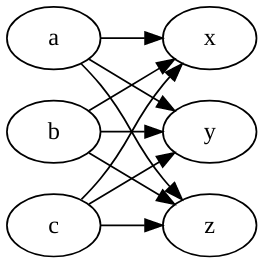
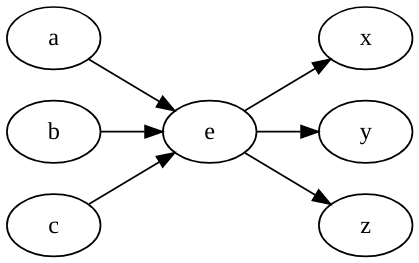
We return now to $, which we will define as an event without any properties, abstract silence or abstract juncture, a virtual pause. This is mostly for notational convenience, but it could turn out to be used as a basis for some segmentations. For example, sometimes the precedence statements that flow in from the perceptual system will form a bipartite graph between (groups of) events. That is, there will be events a,b,c and x,y,z such one cluster of elements mutually precede the other cluster:


The left-hand graph is the graph K3,3, and is one of the two identifiers for non-planar graphs (the other being K5). That is, no graph containing K3,3 can be represented in two dimensions without crossing lines. Perhaps in such cases a $ event e is inserted to establish planarity. (Though why abstract planarity would be important here is not at all clear.) Depending on how common this situation is, this could “chunk” events, or provide alignment possibilities to guide LTM access. 

We could add a clock, and thereby make a timing tier, but we won’t do that either for now. (But we think that such things will ultimately play an important role, see Gallistel & King 2009, and Giraud & Poeppel 2012. The auditory system does have a couple of endogenous clocks, see below.)

If you want to bring SPE back (we are repressing our inner Justin Timberlake here…) then you will need to:

  • add [+F] synonyms for every [F]
  • add all the [-F] definitions
    (IF NOT [+F] THEN [-F] since SPE didn’t allow underspecification), 
  • constrain temporal relations to be linear
    (∀ a, b, e IF a^e AND b^e THEN a=b; IF e^a AND e^b THEN a=b) 
  • constrain temporal relations to be complete
    (∀ e ∃ a, b such that e = # OR e = % OR a^e^b) 

Definitions for things like [αF] are left as an exercise for the reader. Although we like SPE, we won’t do this either.

Also we will include substance to the extent that it will allow for the identification of the articulator-free (manner) features. We’ll assume here that they are privatively coded [stop], [trill], [fricative], [liquid], [approximant], and that these interface to degrees and kinds of innervation to the articulators (i.e. a full ballistic gesture with [stop]). These, along with [nasal] are the landmarks of Stevens 2000 (see also various work by Carol Espy-Wilson and her colleagues), and constitute a proposal for a coarse-coded phonological “primal sketch” (Poeppel & Idsardi 2012). Given that we can have events with multiple properties, we can have events like [stop, Coronal] which would ultimately execute a full closure by the tongue blade. We can also if we want combine the insights of Clements and Rubach on affricates as strident stops with Steriade’s aperture theory. In such cases an event [stop, fric, Coronal, lateral] could be split into two events  [stop, Coronal]^[fric, Coronal, lateral] to interface with motor control. (For those wanting mutually exclusive coding of manner features, i.e. *[stop, fric] = [stop] NAND [fric], just drop the [fric] feature from the “abstract” starting representation for the affricates.) 

Finally, in order to interface with the dual timescale analysis being performed by the auditory system (Poeppel 2003, Giraud & Poeppel 2012), we will allow events which indicate syllables, σe. These events as they come out of the auditory system are innervated along a relatively slower time scale, in theta band (~ 4-8 Hz). The featural elements, like [spread], will be modulated by low gamma band oscillations (~ 20-40 Hz). Together (along with delta band) these form an endogenous clock (see Gallistel and King 2009) which permits the identification of precedence relations inside perception. It is also almost certainly the case that auditory streaming (Bregman 1990) affects the ability to identify precedence relations. Telling that a single neuron displayed an on-off-on pattern (and therefore concluding that ∃ x, y Fx^Fy) is easier than recognizing Fx^Gy for elements across streams, Fink, Ulbrich, Churan & Wittmann 2006. Is this enough by itself to induce “reflective” tier effects in the phonology? Would something like this make tier effects exogenous to the model (the perceptual input to the phonology is just more likely to include x^y statements within a stream)? We don’t think that there are easy answers to these questions.

Given how little specification that we have given to the model, there are few limits on what we can compute with it at the moment. But we are sure that this gives us enough “wiggle room” to capture the observations about linearity, invariance, and biuniqueness in Chomsky 1964.

We want to emphasize here that we do agree with SFP that the computation procedures within phonology are a complex, composed function, which is decomposable into simple functions, though here they are graph-theoretic operations (which are called transductions in that literature) on the events (nodes), properties (features) and precedence relations (links) in the phonological graph. Again, this is like Raimy 2000 without a timing tier, and Autosegmental Phonology without pre-defined tiers or association lines; just let precedence statements be stated between any pair of events, which might have any number of properties.

Next time: Dogs and cats

Wednesday, April 4, 2018

A modest proposal

Bill Idsardi and Eric Raimy


[Note: the following owes tremendous debts to Jeff Heinz and Paul Pietroski, but that does NOT imply their endorsement. But they can provide endorsements or disavowals in the comments if they want to. They also have the right to remain silent, because ‘Murica.]

Taking phonology to be the mind/brain model for speech, it needs to have interfaces to at least three other systems: the articulatory motor control system (action), the auditory system (perception) and the long term memory system (memory), forming a Memory-Action-Perception (MAP) loop (Poeppel & Idsardi 2012). Likewise, signed languages will have to have interfaces to action (the motor system for the hands, arms, etc.), perception (the visual system) and to memory. As discussed in the comments last week, we think therefore that sign language phonology probably also includes spatial primitives which spoken language phonology lacks. 

So the data structures inside phonology proper must be able to effectively receive and send information across those interfaces. This condition is a basic tenet of the minimalist program. Pietroski (2003: 198 Chomsky and his critics) is on-point and unmistakable :

"Indeed, a sentence is said to be a pair of instructions -- called "PF" and LF" -- for the A/P and C/I systems. If these instructions are to be usable by the extralinguistic systems, PFs and LFs may have to respect constraints that would be arbitrary from a purely linguistic perspective."

(And see Chomsky's replies in the same book for further remarks on the importance of the interface conditions, e.g. p 275.) That is, the data structures inside phonology must be sufficiently similar to the data structures in the directly connecting modules to allow for the relevant information to be transferred. Such interface conditions are also definitely part of Marr's program, though people seem to miss this point, perhaps because it's buried in his detailed account of the visual system, e.g. pp 317 ff on transforms between coordinate systems.

Reiss and Hale often refer to the interfaces as “transducers”, but the whole of phonology is a transducer between LTM and motor control, and between perception and LTM (“From memory to speech and back”, Halle 2003). (There also seem to be some connections between action and perception that do not include a way station at memory. We ignore those things here.) Moreover, at times the SFP proposals seem to imply transducers which would have very impressive computational abilities, and which look implausible to us as direct interfaces which can be instantiated in human neural hardware (which in perceptual systems seem largely limited to affine transformations and certain changes in topology and discretization such as are accomplished in the vision system, Palmer 1999, though see Koch 1999 for an idea of how much computation a single neuron might be able to do -- a lot).

So, first, we will adopt the proposals of Jakobson, Fant and Halle 1952 (minus the acoustic definitions, which are nevertheless very relevant for engineering applications), and Halle 1983 regarding distinctive features and their neural instantiation, but drawing the feature set from Avery & Idsardi 1999. Here is a relevant diagram from Halle 1983:


And here is A&I’s wildly speculative proposal:


We believe that SFP (or at least the Reiss & Hale contingent) is sort of ok with this, although they remain more open on the feature set (which for them continues to include things like [±voiced] -- by the way, also in the Halle 1983 figure above -- despite Halle & Stevens 1971, Iverson & Salmons 1995 et seq).

We understand the perception side to involve neural assemblies including spectro-temporal receptive fields (STRFs, Mesgarani, David, Fritz & Shamma 2008, Mesgarani, Cheung, Johnson & Chang 2014) and a coupled dual-time-window temporal analysis (Poeppel 2003, Giraud & Poeppel 2012). On the action side, we’ll go with Bouchard, Mesgarani, Johnson & Chang 2013 and another off-the-shelf component, Guenther 2014. Much less is known about the relevant memory systems, but we’ll take stuff like Hasselmo 2012 and Murray, Wise & Graham 2017 as some starting points.

Most importantly in our opinion (we've been telegraphing this point in previous posts) we need a reasonable understanding of what “precedes” is, and we think precedes needs to be front and center in the theory. We feel that it is very unfortunate that phonological practice has often favored implicit depictions of “precedes” (as horizontal position in a diagram) rather than being explicit about it (but we’ve rehearsed these arguments before, to not much effect). We take “precedes” to be a temporal relation at the action and perception interfaces, providing the basis in the phonology for notions such as “before” and “after” and “at the same time, more or less”. (And for speech “more of less” appears to be about 50ms, Saberi & Perrott 1999, again see Poeppel & Giraud & Ghitza &co. It's not impossible for the auditory system to detect changes that are faster than this, but such rapid transitions will be encoded in phonology as features rather than as separate events.) We feel that it bears repeating here that the precedes relation in phonology is interfacing to the data structures and relations for time that are available in motor control and auditory perception and memory, which themselves are not going to capture perfectly the physical nature of time (whatever that is). That is, the acuity of precedes will be limited by things such as the fact that there is an auditory threshold for the detection of order between two physical events. (A point that Charles brought up in the comments last week.)

There are a number of ways to construct pertinent data structures and relations, but we will choose to do this in terms of events, abstract points in time (compare Carson-Berndsen’s 1998 Time-Map Phonology in which events cover spans or intervals of linear time). This will probably seem weird at first, but we believe that it leads to a better overall model. NB: This is absolutely NOT the ONLY way to go about formalizing phonology. SFP (Bale & Reiss 2018) take quite a different approach based on set theory. We will discuss the differences in a later post or two.

Within the phonology that means that we have at least:

  1. events/elements/entities, which are points in abstract time. We will use lower case letters (e, f, g, ...) to indicate these.
  2. features, which we construct as properties of events. When we don’t care what their content is we will use upper case letters to indicate them (F, G, H, …). So Fe means that event e has feature F. We will enclose specific features in brackets, following common usage in phonology, e.g. [spread]e. Notationally, [F, G]e will mean Fe AND Ge. We will drop the event variable when it’s clear in context (think Haskell point-free notation).
  3. precedes, a 2-place relation of order over events, notated e^f (e precedes f). The exact “meaning” of this relation is a little tricky given that we are not going to put many restrictions on it. For example, following Raimy 2000, we will allow “loops in time”. We're not sure that model internal relations really have any "meaning" apart from how they function inside the system and across the interfaces, but if it helps, e^f is something like "after e you can send f next" at the motor interface and "perceived e and then perceived f next" at the perceptual interface.

(We’ll do things in this way partly because of Bromberger 1988, though I [wji] still don’t think I fully understand Sylvain’s point. Also, having (1-3) allows us to steal some of Paul Pietroski’s ideas.)


So far (1-3) give us a directed multigraph (it allows self-edges and multiple edges between nodes); and with it comes with no guarantees of connectedness yet. (And Jon Rawski would like us to point out that there's a fore-shadowing of a model-theoretic approach here. Jon, please say more in the comments if you'd like.) We suppose this thing needs a name, so let’s call it Event-Feature-Precedence (EFP) Theory (would PFE be better? that could be pronounced [p͡fɛ], as in “[p͡fɛ], that’s not much of a theory”). With (1-3) we have a feature-based version of Raimy 2000 (as opposed to its original x-tier orientation), but since we will allow events to have multiple properties (features), we can recreate Raimy diagrams, such as this one for “kitty-kitty” where the symbols are the usual shorthands for combinations of features.


And now, for some random quotes about non-linear time (add more in the comments, please!):

“This time travel crap, just fries your brain like a egg.” Looper

“There is no time. Many become one.” Arrival

“Thirty-one years ago, Dick Feynman told me about his "sum over histories" version of quantum mechanics. "The electron does anything it likes," he said. "It just goes in any direction at any speed, forward or backward in time, however it likes, and then you add up the amplitudes and it gives you the wave-function." I said to him, "You're crazy." But he wasn't." Freeman Dyson
(Note: Freeman Dyson is a physicist, not a movie).
We also take properties (features) to be brain states, as in Halle 1983. Then [spread]e means that event e has the property spread glottis. (For us being brain states doesn't preclude the properties from being other things too. We mean (1-3) in a Marrian way across implementations, algorithms and problem specifications.) This discussion will sometimes be cast as if features are single neurons. This is certainly a vast over-simplification, but it will do for present purposes. For us this means that a feature (= neuron (group)) can be “activated”. (The word “feature” seems to induce a lot of confusion, so we might call these constructs fneurons, which we will insist should be pronounced [fnɚɑ̃n] without a prothetic [ɛ].) The innervation of [spread] fneuron in event e (in conjunction with the correct state of volitional control circuits) will cause a signal to be sent to the motor control system that will ultimately innervate the descending laryngeal nerve to innervate the posterior cricoarytenoid muscle (and reciprocally de-innervate the lateral cricoarytenoid muscle). On the perception side, we assume (facts not in evidence because we’re too lazy to look through all of the STRFs in Mesgarani et al 2008) that there are auditory neurons whose STRFs calculate the intensity difference between bark bands 1 and 2 as versus bark bands 3 and 4 (probably modulated by the overall spectral tilt in bark bands 5 to 10). The greater this intensity difference the more likely a [spread] fneuron is to be innervated (activated past threshold). We doubt that there’s much effect of volitional control on the perceptual side, as auditory MMNs can be observed in comatose patients, or at least in those that eventually recover, 30/33 patients in Fischer, Morlet & Giard 2000. To Charles's point last week about phonological delusions, it's well known that large positive values of voice onset time (VOT) can signal [spread] also, without the inclusion of voice quality differences in the first few pitch periods of the vowel. So the working hypothesis is that the neurons for [spread] are connected to auditory neurons with at least two kinds of STRFs, the bark-based one mentioned above, and a neuron yielding a double-on response, see various publications by Steinschneider.

As many people are aware, graphs (and multigraphs) are usually defined over sets (or bags or multisets) of vertices and edges. We haven’t included the set stuff here. Why not? The idea, for the moment at least, is that we’re calculating in a workspace, and there isn’t significant substructure in the workspace in terms of individuated phonological forms. So the workspace universe provides the set structures, such as they are, the events, the properties of the events and the relations between events. This could well be a big mistake, as it seems to preclude asking (or answering) questions like “do these two words rhyme?” as this would involve comparing sub-structures of two different phonological representations. That is, in order to evaluate rhyme (or alliteration, or …) we would have to evaluate/find a matching relation between two sub-graphs, so we would need to be able to represent two separate graphs in the workspace and know which one was which. To do this we could add labels to keep track of multiple representations, or add the extra set structure. There are (different) mathematical consequences for either move, and it isn’t at all clear which would be preferable. So we won’t do anything for now. That is, we’re wimping out on this question.

Finally, we will say once more that there are some strong similarities between this approach and Carson-Berndsen’s work. But in Time-Map Phonology time is represented using intervals on a continuous linear timeline whereas here we have discretized time instead and we allow precedence to be non-linear.

Next time: It’s Musky

Nature: Tom Lehrer

Bill Idsardi

In Nature this week, a nice piece on Tom Lehrer, mathematician and musical satirist. I started taking piano lessons when I was eight, and I really didn't like the classical pieces. Fortunately, my piano teacher at that time was very understanding (not so much my later ones) and she let me pick other kinds of pieces. So for my first recital (held in her living room for her students and their parents) I played Henry Mancini's Pink Panther theme and Tom Lehrer's MLF Lullaby, but I just played the tune, I didn't sing the words. Here's Tom Lehrer performing it. 

Monday, April 2, 2018

Morris Halle 1923-2018

Bill Idsardi

Today is a very sad day for lots of people, including me. Morris Halle passed away early this morning. Here is the MIT announcement. Morris was my thesis advisor, and a wonderful mentor and friend to me in many, many ways.

Here's a brief reminiscence that often comes back to me. When I came to MIT in 1988 Morris had a house in Cambridge not far from Porter Square. My wife, Jane and I lived in a house in Somerville, about midway between Porter and Davis. This meant that there were lots of times when Morris and I were heading home at the same time, so we would ride the T together, and mostly he would tell me stories. I'm sure that many of the stories were really parables, and sometimes I think I got the lesson, but often I think I didn't, meaning that I didn't even realize there was a lesson. But like all good parables, the stories were captivating in and of themselves.

Sometimes, though, we would be going home separately, but at about the same time, so we might end up on the same train but in separate cars. There is one particular time I recall quite vividly even today. When the train stopped at Porter and I got out, I could see that Morris had been on that train too, a couple of cars ahead of me. (He would stand in the exact spot on the Kendall platform so that he would be delivered right at the foot of the stairs when the train arrived at Porter.)  The Porter T station has the longest escalator in the MBTA system (143 feet Wikipedia says). Anyway, as I was walking out several yards or so behind him, I could see Morris get on the escalator and take the stairs two at a time all the way up to the top. He was 68 years old then. For me it was yet another display of how Morris tackled problems -- head on and all in. I found that truly inspiring then, and all the more so now.